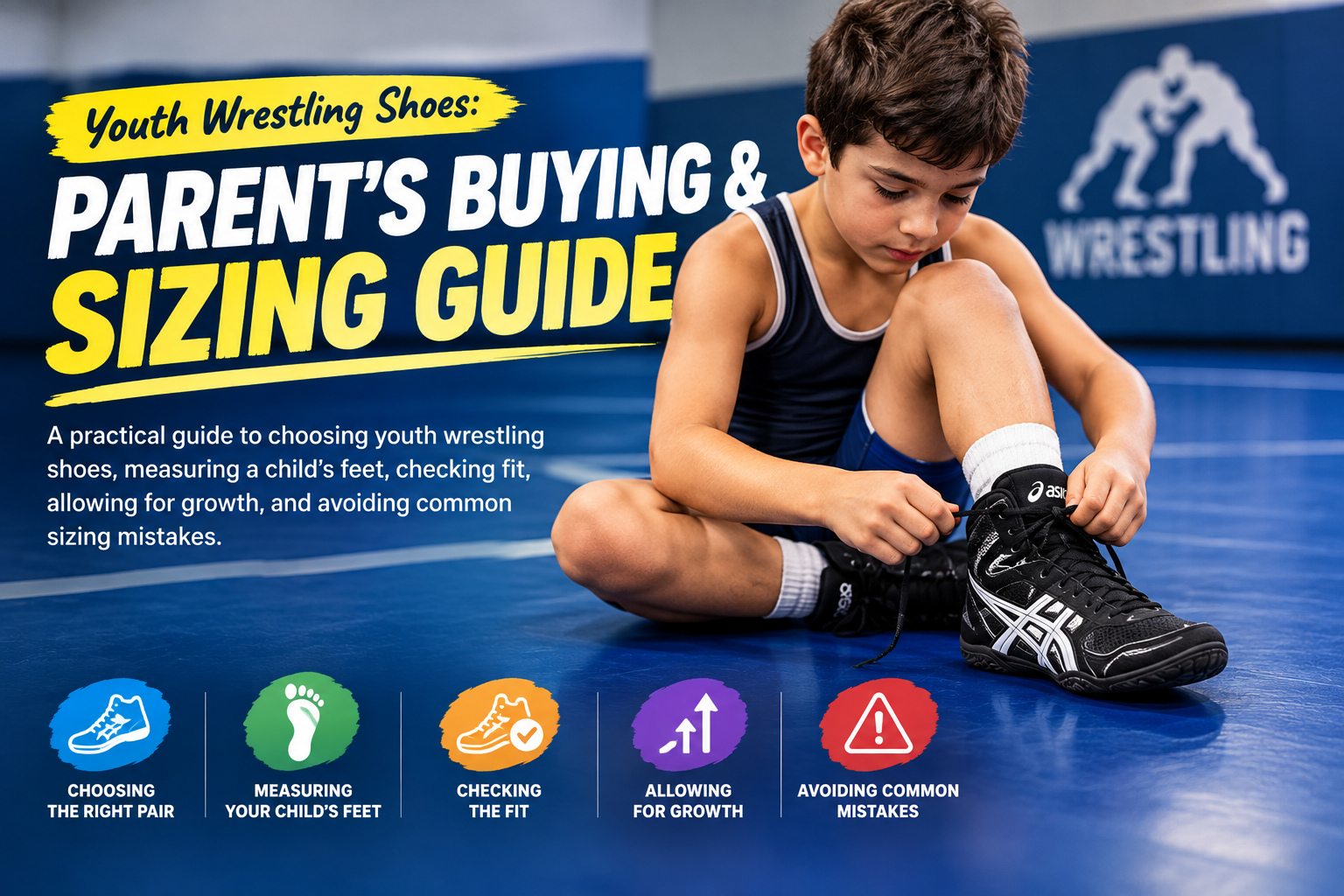
Buying a first pair of wrestling shoes can feel harder than it should. Your child may be growing quickly, every brand uses a slightly different size chart, and a shoe that feels fine while standing can become uncomfortable during a stance, shot, or scramble.
The safest approach is simple: measure both feet, use the specific brand's chart, and judge the fit while your child moves. A wrestling shoe should feel close and secure without crushing the toes or leaving enough room for the foot to slide. Buying several sizes too large "for growth" usually creates a different problem: poor heel control and extra movement inside the shoe.
This guide covers youth wrestling shoe sizing, fit checks, width, growth allowance, care, and the questions parents ask before a first tournament. The product examples are current manufacturer listings. They are not ranked as the best shoes until Wrestling Fit Lab completes parent and youth testing.
What makes youth wrestling shoes different?
Youth wrestling shoes are built for a different job than running shoes. A wrestler needs to stay close to the mat, change direction quickly, and keep the foot from sliding inside the upper. The shoe also needs to flex where the child bends and provide traction without feeling like a heavy basketball shoe.
Look for these features:
- A flat, flexible outsole made for a wrestling mat
- A secure heel and ankle opening that does not collapse during a stance
- A breathable upper that can dry between practices
- Laces or a strap that can be tightened without creating pressure points
- Enough forefoot width and depth for the toes to lie flat
These features do not guarantee a good fit. Two shoes with similar features can feel very different because the last, upper shape, and internal volume differ. Treat the size printed on the box as a starting point, not a verdict.
How to measure a child's feet at home
Measure before ordering, even if you know your child's usual sneaker size. Children grow in spurts, and the larger foot may not match the size you have been buying.
The wall-and-paper method
- Put a sheet of paper on a hard floor with one edge against a wall.
- Have your child wear the socks used for wrestling practice.
- Ask the child to stand normally, with the heel lightly touching the wall and weight spread across both feet.
- Trace around one foot or mark the heel and the longest toe. Repeat on the other side.
- Measure from the wall edge to the longest toe. Record the longer foot in millimeters or centimeters.
- Measure the widest part of each foot as well. Width is useful when a child feels pressure at the ball of the foot even though the length seems correct.
- Compare the measurements with the exact manufacturer's chart for the model you are considering.
Nike's current kids' footwear guide also tells parents to measure both feet, use the longer measurement, and size up when the measurement falls between chart sizes. Its printed guide must be used at 100 percent scale, or the measurement can be wrong. See the Nike kids' footwear size guide.
ASICS provides a similar standing measurement process and advises adding 1 to 1.5 centimeters in its general measuring instructions. Do not automatically add that amount to a wrestling shoe order. Use the model's own chart and then perform an in-shoe fit check, because wrestling shoes need more control than a roomy everyday sneaker. The ASICS measuring guide is useful for the measurement itself.
Use the longer foot, then check the shape
The longer foot decides the starting size. The wider or higher-volume foot decides whether that size is actually wearable. If one foot is longer and the other is much wider, a longer size may create too much extra length while still squeezing the wider foot. That is a reason to look for a different model or a wide option, not a reason to keep sizing up blindly.
How much growing room should youth wrestling shoes have?
Children need room to grow, but a wrestling shoe cannot function like a loose school shoe. The American Academy of Orthopaedic Surgeons' FootCareMD recommends roughly one-half inch between a child's longest toe and the front of a removable insert. It also recommends checking the shoe's length, width, and depth, and looking for redness or blisters after wear. Read the complete FootCareMD children's shoe-fitting guide.
Use that measurement as an upper check, not an invitation to buy a shoe several sizes too big. When the child stands with the heel against the rear of the shoe:
- The toes should not touch the front.
- The toes should not be curled to avoid the front.
- The heel should not lift noticeably when the child walks or rises onto the toes.
- The foot should not slide forward during a controlled lunge or penetration step.
- The upper should not leave deep red marks after a short try-on.
If the shoe is comfortable only when the laces are pulled extremely tight, the shape is probably wrong. If the child says the shoe feels loose but the toes have plenty of room, try a different model before increasing or decreasing size.
The five-minute youth wrestling shoe fit test
Try the shoes indoors on a clean surface while the return window is open. Use the same socks the child will wear at practice. Ask the child to describe pressure and movement instead of simply asking, "Do they feel okay?"
1. Standing check
With both shoes laced, ask the child to stand normally. Check that the toes lie flat, the upper is not pressing on the toenails, and the heel is seated at the back. The shoe should feel snug but not painful.
2. Stance and level change
Have the child hold a wrestling stance, lower the hips, and return to standing. Watch for heel lift, the foot rolling over the edge of the sole, or the toes bunching at the front.
3. Penetration step
Use a slow, controlled penetration step. The shoe should bend with the foot and remain connected to the mat. A child who reaches for the front of the shoe with the toes may be trying to stop the foot from sliding.
4. lateral shuffle and pivot
Have the child shuffle in both directions, then pivot slowly. Listen for the foot moving inside the shoe. A little lace movement is normal. A heel that repeatedly lifts or a foot that slides across the insole is not a secure fit.
5. Short comfort check
Keep the shoes on for 10 to 15 minutes indoors. Remove them and check the skin around the toes, sides of the foot, heel, and ankle. Redness that fades quickly can come from normal contact. A sharp pressure point, blister, numbness, or persistent mark is a reason to stop and reassess.
This home check does not replace a hands-on Wrestling Fit Lab test. It gives a parent a repeatable way to catch obvious problems before the first practice.
Width and depth matter as much as length
Many parents solve a width problem by buying a longer shoe. That can leave too much space in front and make the child work harder to control the shoe. Check these areas separately:
- Ball of the foot: The widest part should sit inside the widest part of the shoe. The child should not feel a hard ridge pressing into the little-toe side.
- Toe box: The longest toe should have room to extend. The top of the shoe should not press on the toenails.
- Instep: The lacing should hold the foot without creating a narrow pressure band across the top.
- Heel: The heel should stay in place when the child changes direction.
- Ankle opening: The collar should contact the ankle without rubbing raw skin.
FootCareMD notes that a child's shoe needs enough length, width, and depth, and that a rounded toe box gives the toes more room to move. It also says a new shoe should be comfortable from the start rather than relying on a long break-in period.
For a wide foot, start with a model that has a wider shape or a published wide option. Do not assume that a half-size increase creates the same width increase. It changes length too, and the heel may stop locking down.
Youth size labels can be confusing
Youth wrestling shoes may use labels such as K10, K13, 1Y, or 4Y. A 4Y label is not always interchangeable with a women's 4 or a men's 4 across brands. Even within one brand, the chart can change by region or product line.
Use this order when converting sizes:
- Measure the child's longer foot.
- Open the product page for the exact model.
- Use the model's US kids chart, including the centimeter or millimeter row.
- Check the return and exchange policy before trying the shoes.
- Confirm the fit indoors before practice.
Do not choose a youth size from age alone. Two children the same age can have very different foot lengths and widths.
Current youth wrestling shoe examples
The table below is a research starting point, not a ranking. Product descriptions come from the manufacturers. Wrestling Fit Lab still needs parent interviews, youth try-ons, and original measurements before assigning a fit score.
| Model | What the listing says | What a parent should verify |
|---|---|---|
| ASICS MATFLEX 7 GS | Breathable mesh, supportive overlays, EVA sockliner. Standard width. | Forefoot width, heel security, standard shape fit. Amazon | ASICS |
| ASICS Kids Wrestling Collection | Grade-school MATFLEX and SNAPDOWN models. Availability varies. | Exact model, size range, width label, return window. ASICS |
| RUDIS Colt 4.0 Youth | Breathable mesh, low-profile outsole, flexible collar. Usual size = snug; +0.5 = roomier. | Actual heel and forefoot on the child. RUDIS |
| RUDIS Courage Youth | Mesh, micro-suede rand, wrapped outsole. Some colorways unavailable. | Live stock, size availability, exchange terms. RUDIS |
The word "youth" does not tell you whether a shoe is wide, narrow, stiff, or roomy through the instep. Those are fit questions that require measurements and try-on evidence.
What to pack and what to check at practice
Pack clean wrestling socks, a small towel, and a bag that lets the shoes dry separately from damp gear. After practice, check the outsole for mat debris and wipe the upper according to the manufacturer's care instructions. Do not put a pair in a hot dryer unless the brand specifically allows it; heat can change adhesives and materials.
During the first few practices, ask about specific symptoms:
- toes hitting the front during a shot
- numbness or tingling
- burning at the ball of the foot
- heel movement during a pivot
- rubbing around the ankle
- blisters or red marks that remain after the shoes come off
Persistent pain is not a normal break-in phase. Stop using the shoes and ask a qualified foot or medical professional if the issue continues. A child with a known foot condition, recurring pain, or difficulty finding a tolerable fit may need individual clinical advice rather than another size guess.
When should a child get a new pair?
Check fit at the start of every season and whenever the child reports pressure or slipping. FootCareMD notes that children's feet can grow in spurts and that some children need new shoes every three to four months, depending on age, activity, and growth rate. Wrestling shoes may last longer or shorter depending on training volume and mat wear, so use the actual fit and condition as the decision point.
Replace the pair when:
- the toes touch the front or curl inside the shoe
- the heel no longer stays seated
- the outsole is visibly worn smooth in key traction areas
- the upper has torn or the laces no longer hold tension
- the shoe has developed a permanent crease or pressure point
- the child has outgrown the width even though the length seems acceptable
Parent's buying checklist
Save this list before ordering:
- Measure both feet while standing.
- Record the longer foot in centimeters or millimeters.
- Measure width if the child has had tight shoes before.
- Use the exact model's current chart.
- Choose the longer foot, not the older sneaker size.
- Allow modest toe space, not a loose "growth" fit.
- Try the shoes with wrestling socks indoors.
- Test stance, level change, penetration step, shuffle, and pivot.
- Check heel movement and skin marks.
- Confirm the return policy before practice.
- Recheck fit throughout the season.
Frequently asked questions
Should I buy youth wrestling shoes one size larger?
Not automatically. Size up only when the manufacturer's chart places the foot between sizes or the fit check shows the current size is short. A shoe that is substantially too long can reduce heel control and make movement less precise.
Can my child wrestle in running shoes?
Running shoes are designed around forward running and cushioning. They are not a reliable substitute for a wrestling shoe's mat-specific sole and close fit. Follow the coach or tournament's equipment requirements, and use a wrestling shoe for wrestling sessions whenever possible.
Are boys' wrestling shoes different from girls' wrestling shoes?
The label is less useful than the actual shape. Compare length, width, depth, heel hold, and the manufacturer's chart. A girl's foot may fit a boys' or unisex model, and a boy with a narrow or wide foot may need a different shape than the label suggests.
How tight should a youth wrestling shoe be?
It should be close enough that the heel does not slide and the foot does not shift during a pivot. It should not cause numbness, sharp pressure, curled toes, or persistent red marks. Comfort during movement matters more than a tight feeling while standing still.
Do youth wrestling shoes need a break-in period?
The child can need a short familiarization period, but pain is not a requirement. A correctly shaped shoe should be comfortable when first tried on. If the child needs to tolerate blisters while waiting for the shoe to soften, return to the fit check.
Bottom line
The best youth wrestling shoes are the ones that match the child's measured foot, keep the heel secure, let the toes lie flat, and stay comfortable through real wrestling movements. Start with measurement and return protection, then compare materials, outsole feel, and price.
Wrestling Fit Lab will add parent and youth tester notes, original photographs, and measured model comparisons before this page carries a "best" recommendation. Until then, use the checklist above and let the child's actual foot shape decide the size.
Related guides
- How should wrestling shoes fit? Toe room, heel lock, and width
- Wrestling shoe size chart and brand conversion guide
- Wide wrestling shoes: the fit-lab guide
- Best wide wrestling shoes under $100
- ASICS Snapdown 4 Wide review
Sources
- FootCareMD: How to Select Toddler & Children's Shoes
- Nike: Kids' Footwear Size Chart
- ASICS: How to Measure Your Shoe Size
- ASICS: MATFLEX 7 Grade School
- ASICS: Kids Wrestling Collection
- RUDIS: Colt 4.0 Youth
- RUDIS: Courage Youth
Editorial and publication notes
- Search intent: Commercial, parent-led comparison and sizing research.
- Required original evidence: At least two parent interviews, one youth try-on session, original fit photographs, and a documented measurement sheet for each tested model.
- Do not claim: A model is "best," "true to size," or wide for all children without product-level testing.
- Health boundary: This is general buying guidance, not a diagnosis or treatment plan.