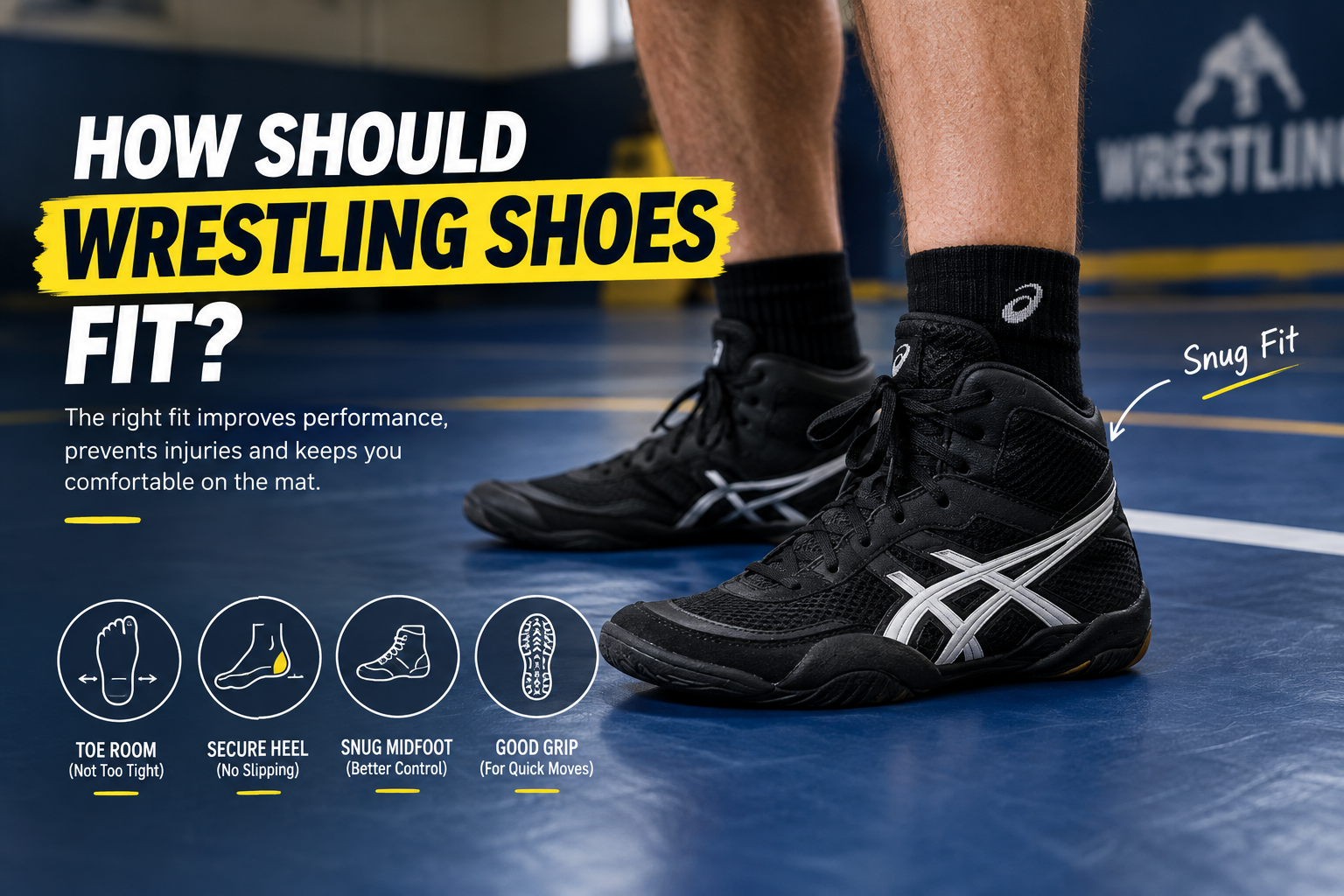
Wrestling shoes should fit close to the foot without crushing it. Your toes should lie flat, your heel should stay planted when you drive forward, and the upper should hold your midfoot without pinching or causing numbness.
That sounds simple, but wrestling shoes are easy to misjudge. A pair can feel comfortably roomy while standing and then slide during a penetration step. Another pair can feel reassuringly tight in the store but become painful after ten minutes of movement.
The goal is not to buy the tightest shoe you can tolerate. It is to find the smallest secure fit that still lets your foot move normally.
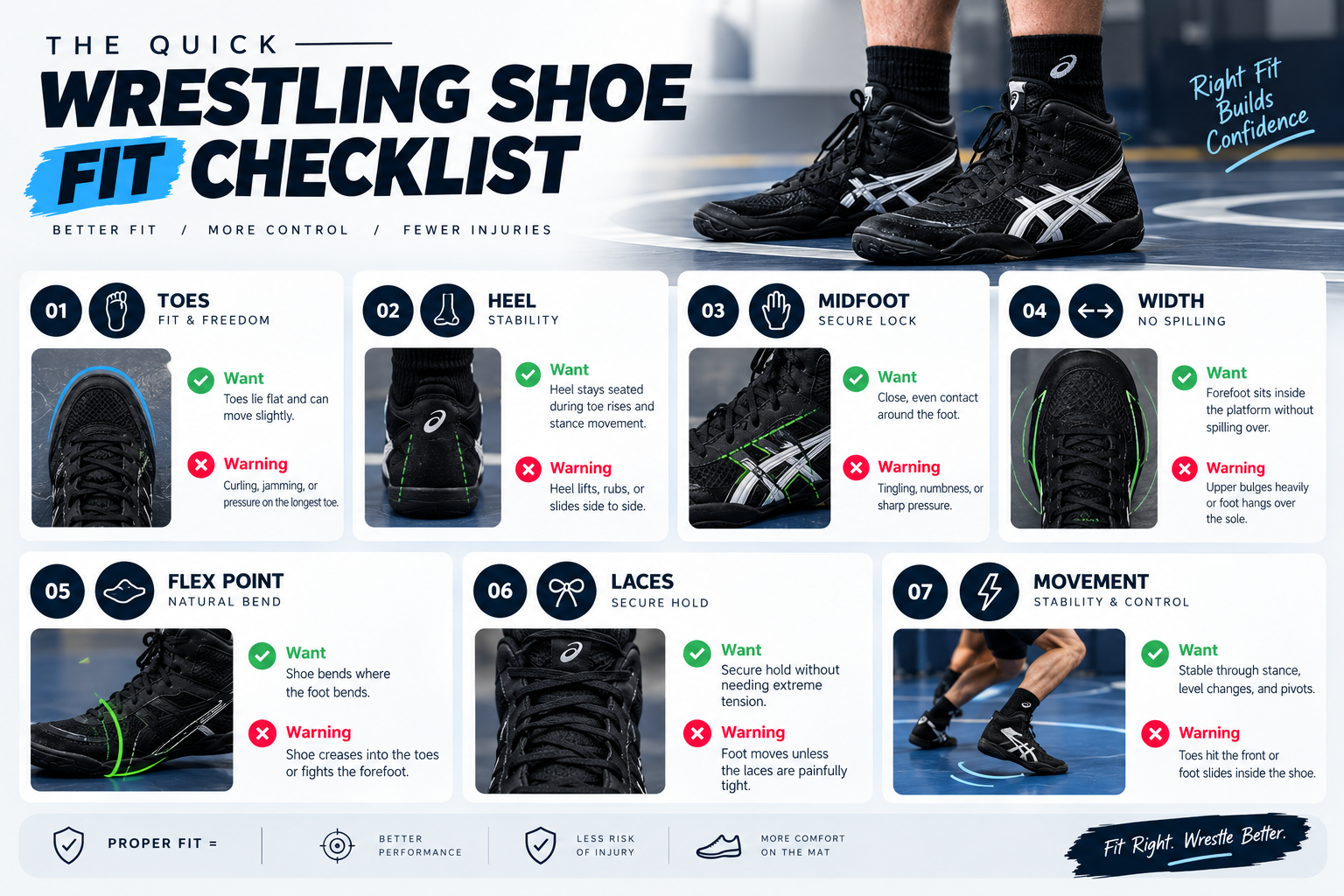
The quick wrestling shoe fit checklist
Toes
Heel
Midfoot
Width
Flex point
Laces
Movement
How tight should wrestling shoes be?
A wrestling shoe normally feels closer than a running shoe. The upper should wrap the foot, and there should not be enough empty space for the foot to shift during quick changes of direction.
Close-fitting does not mean painful. The pressure should feel light and reasonably even across the foot. A hot spot over a toe joint, pressure along the outside of the forefoot, or tingling under the laces is a fit problem, not proof that the shoe is performance-ready.
The American Orthopaedic Foot & Ankle Society advises that athletic shoes should feel comfortable from the start. It also recommends checking that the heel grips firmly, the toes can move freely, and the laces apply even pressure. Those principles are useful for wrestling shoes even though the overall fit is closer.
Do not judge tightness only while sitting. Lace both shoes, stand up, settle into your stance, perform a few controlled level changes, rise onto the balls of your feet, and take several lateral steps. Your feet spread and move under load, so a pressure point that is easy to ignore on a chair may become obvious on the mat.
How much toe room should wrestling shoes have?
There is no single toe-gap measurement that works for every wrestler.
General athletic-shoe guidance from FootCareMD suggests roughly 3/8 to 1/2 inch between the longest toe and the end of a shoe. Wrestling-specific fitting guides often recommend a closer performance fit. For example, Great Call Athletics uses about 1/4 inch as a starting point.
Treat those measurements as reference points, not pass-or-fail rules. Shoe shape, toe-box slope, foot width, toe length, age, and personal comfort all affect the usable space.
A better toe-room test is functional:
- Stand with your weight distributed normally.
- Make sure every toe can lie flat.
- Check that the longest toe is not pressed against the front.
- Drive forward from a wrestling stance.
- Confirm that the toes do not jam into the end of the shoe.
The longest toe is not always the big toe. Check the actual end point of your foot rather than pressing only above the big toe.
If the shoe feels fine until you push forward, it may be too short, poorly shaped for your foot, or not holding your heel securely enough. Sizing up is one possible fix, but it is not the only one. A different model with a more suitable toe-box shape may fit better without adding unnecessary length.
What proper heel lock feels like
Your heel should remain seated in the rear of the shoe while you move. A small change in sock tension is normal, but the heel itself should not noticeably lift with each step.
Use this simple heel-lock test:
- Put on the socks you expect to wrestle in.
- Seat your heel firmly against the back of the shoe.
- Lace from the bottom up with even tension.
- Rise onto your toes five times.
- Take three slow penetration steps on each side.
- Pivot and shuffle laterally.
Watch for vertical heel lift, rubbing at the back, or side-to-side movement. Any of these can reduce the secure feel you need and may create friction.
Before rejecting the size, relace the shoe. Loose lower laces can let the entire foot slide forward, while overly tight top laces can create pressure without actually securing the midfoot. If careful lacing still cannot hold the heel, try another size or a model with a different heel shape.
Width matters as much as length
Many wrestlers respond to a narrow shoe by buying a longer one. That can relieve side pressure, but it may also create excess toe room and heel movement. If the length is right and the forefoot still feels squeezed, the issue is probably width or shape.
Look down at the shoe while standing. The widest part of your forefoot should line up with the widest part of the shoe. This matches the general fitting guidance from FootCareMD. The upper can contour around the foot, but the foot should not visibly hang over the sole platform.
Common signs that a wrestling shoe is too narrow include:
- pressure at the big-toe or little-toe joint;
- numbness or tingling after the laces are tied;
- a pronounced bulge over the edge of the sole;
- needing to leave the lower laces unusually loose;
- relief only after removing the shoe.
If this sounds familiar, use our guide to wide wrestling shoes before ordering a longer size. You can also compare model options in our best wrestling shoes for wide feet guide.
A seven-step try-on test you can do at home
1. Measure both feet
Feet are not always identical. Measure both and use the longer foot as your starting point. Nike gives the same advice in its footwear sizing instructions. For the most useful measurement, stand with your weight on the foot instead of tracing it while seated.
2. Measure late in the day
Feet can be larger after normal activity. Both FootCareMD fitting guides recommend trying athletic footwear later in the day or after activity. This lowers the chance of choosing a fit that works in the morning but becomes restrictive during practice.
3. Wear your wrestling socks
Sock thickness changes the internal volume of the shoe. Test with the same type of sock you will use on the mat. A thick casual sock can make a good shoe seem too small, while a very thin fitting sock can hide a volume problem.
4. Lace the entire shoe
Do not test a half-laced shoe. Start at the bottom and remove obvious slack as you work upward. Aim for firm, even tension rather than pulling the top eyelets as tightly as possible.
5. Check the toes and forefoot
Stand and confirm that your toes lie flat. Press around the widest part of the forefoot and note any concentrated pressure. Bend through the ball of the foot and check that the shoe flexes in the same place.
6. Test wrestling movements
On a clean, safe surface, perform controlled stance steps, level changes, toe rises, pivots, and penetration steps. Do not wear unreturned shoes on a mat or surface that could mark the outsole.
7. Keep the pair on for several minutes
Some problems need time to appear. Pay attention to growing pressure, numbness, hot spots, or a heel that gradually works loose. A new upper may soften somewhat, but a shoe that is painful or badly shaped from the start is a poor bet.
Signs your wrestling shoes are too small or too big
Too small
- Toes curl or touch the front under load
- Sharp pressure at toe joints
- Numbness or tingling
- Forefoot spills over the sole
- Pain increases the longer the shoe stays on
Too big
- Foot slides forward during shots
- Heel rises during toe stands
- Laces must be overtightened for control
- Upper wrinkles heavily over the forefoot
- Side-to-side movement during pivots
One symptom alone does not always identify the cause. Toes hitting the front can mean the shoe is too short, but it can also happen when poor heel hold lets the foot slide forward. Check the whole fit before changing sizes.
How should youth wrestling shoes fit?
Youth shoes need enough room for comfort, but buying a much larger pair for future growth usually compromises the fit today. Excess length can allow the foot to slide and may force the child to curl the toes or overtighten the laces for control.
Measure both feet, use the larger measurement, and compare it with the current brand chart. If the child is between sizes, follow the manufacturer's guidance and, when possible, compare adjacent sizes in person. Recheck the fit during the season because growing feet can change quickly.
Ask the child specific questions. "Does it hurt?" often produces a quick no. Better questions include:
- Does any toe touch the front when you drive forward?
- Do you feel squeezing at the sides?
- Does your heel move up and down?
- Do you feel tingling anywhere?
Also look at the foot after the shoes come off. Persistent red pressure marks, rubbing, or complaints that begin later in practice deserve attention.
Should you size up or down in wrestling shoes?
Start with your measured foot length and the current size chart for the exact brand. ASICS, for example, includes wrestling shoes in its official footwear size guide. A size number is only a starting point because models can differ in toe shape, width, padding, and internal volume.
Do not automatically size down to get a "wrestling fit." If your toes are compressed, the shoe is too small or the wrong shape. Do not automatically size up for width either, because extra length may introduce heel slip.
When ordering online, the safest approach is to:
- measure both feet;
- read the chart for that brand;
- check whether the retailer allows clean indoor try-ons;
- order two nearby sizes if the return policy and budget allow;
- keep the pair that passes the movement test, not the pair with the preferred number.
Do wrestling shoes need a break-in period?
Materials can soften and conform with wear, but break-in should not be used to excuse pain, numbness, toe compression, or a badly placed flex point. FootCareMD advises choosing athletic shoes that are comfortable when you try them on instead of expecting them to stretch into the right fit.
A reasonable new-shoe sensation is a close, structured upper that becomes less noticeable as you move. A warning sensation is a specific area that becomes increasingly painful or causes altered movement.
Frequently asked questions
Should your toes touch the end of wrestling shoes?
Your longest toe should not be jammed against the end, especially when you drive forward. A close fit is normal, but your toes should remain flat and should not hit the front during wrestling movements.
Is heel slip normal in wrestling shoes?
Noticeable heel lift is a sign that the fit or lacing needs attention. Relace the shoe with even tension and repeat the toe-rise and penetration-step tests. If the heel still moves, compare another size or a different heel shape.
Can tight laces fix a shoe that is too wide?
Only to a point. Laces can fine-tune volume, but they cannot correct a major mismatch between the shoe and your foot. If securing the foot requires painful lace pressure, try a narrower or lower-volume model.
What if one foot is larger than the other?
Fit the larger foot first. Then use careful lacing on the smaller side if needed. If the difference is substantial or causes ongoing discomfort, a qualified footwear specialist or foot-health professional can help assess your options.
When should I stop wearing a pair?
Stop and reassess if the shoes cause persistent pain, numbness, skin damage, or a change in the way you move. Fit guidance cannot diagnose a foot problem. Seek a qualified medical professional when symptoms continue after the shoes are removed.
The bottom line
The right wrestling shoe feels secure, not punishing. Your toes stay flat, your heel stays planted, the widest part of your foot matches the shoe, and the laces hold you without creating pressure points. Test those conditions during wrestling movements and let the fit decide the size.
Editorial and production notes
Evidence standard: This article synthesizes guidance from the American Orthopaedic Foot & Ankle Society, current manufacturer size charts, and wrestling-specific fitting sources. It does not claim hands-on testing of any shoe model.
Required original media before publication:
- Labeled foot diagram showing longest toe, forefoot width, and heel.
- Three-photo fit check showing toe space, forefoot alignment, and heel-lock movement.
- Branded one-page Wrestling Shoe Fit Checklist PDF or printable image.
Suggested featured-image brief: Close-up of an unbranded wrestling shoe being fitted on a clean mat, with the heel seated and laces partially tightened. Landscape 1600 × 900, high contrast, no text baked into the image, no visible third-party logo.
Suggested image alt text: Wrestler checking the heel and laces of a snug-fitting wrestling shoe.
CTA asset link placeholder: /downloads/wrestling-shoe-fit-checklist/
Affiliate disclosure: Add the site's standard disclosure only if affiliate product links are inserted later.
Reviewer fields:
- Writer: [Name]
- Technical reviewer: [Name and relevant credentials]
- Last reviewed: September 6, 2026
- Next review: March 2027 or sooner if manufacturer charts change